
Turners’ Hall

As stewards of Louisiana history, we feel it’s important to document the journey taking place within our own walls. On December 14, 2024, our beloved headquarters, Turners’ Hall, suffered a partial collapse. The building, which has stood witness for more than 150 years as the City of New Orleans changed and grew around it, is now undergoing its own evolution. In this series, we’ll share stories and photos on our progress as we work to restore Turners’ Hall.
Supporting a Historic Building
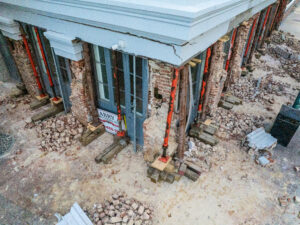
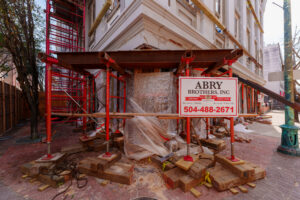
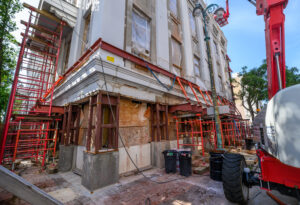
How do you keep a five-story, 150-year-old building from falling down? That was the question posed in the middle of the night on December 14, 2024, and it was one that had to be answered immediately.
Patrick Abry, whose family business Abry Brothers, Inc., has been shoring buildings and securing foundations on New Orleans’ shifting landscape for more than 180 years, arrived at 938 Lafayette Street at around 1 a.m.
When he got to Turners’ Hall, he joined discussions already in progress between the New Orleans Fire Department, Police Department, Department of Safety and Permits, and the Louisiana Endowment for the Humanities – the building’s owner and occupant – about how to secure the building and keep the surrounding community safe. They would soon be joined by engineering firm Morphy, Makofsky, Inc., and construction firm Woodward Design+Build.
“We collectively sought all of the best minds to ascertain what was wrong with the building,” said Pat Carrier, the LEH’s chief operating officer.
The reopening of O’Keefe Avenue marks a major milestone in the shoring process, not only for the community but for the building itself, which is now resting on its new foundation and deemed safe for vehicles to once again rumble past its walls.
It’s the culmination of a process that began bright and early the morning after the building’s partial collapse. Shoring – the temporary support of a structure to either secure it or to allow for repairs – began that morning but would be an ongoing process for more than a year.
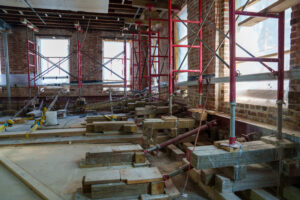
“We just started to get some equipment under to get it somewhat stabilized. In the shoring process when we deal with these collapses, once you start getting some equipment under it, then you get a little
bit safer, and you can move to a different area,” said Greg Abry, Abry Brothers president and the sixth generation to run the company (Patrick and his brother Thomas, who also responded, being the seventh). “You identify these hot spots, so to say, where we’re
going to go first and get that secure, and then move into other areas. So every day was a different viewpoint of where we were going to go and what equipment we had to have at the ready to be able to get in there and stabilize.”
Throughout the process, the age and construction of Turners’ Hall would prove to be a challenge. The location, right in the heart of New Orleans’ Central Business District, would be as well.
“We were very nervous with the delicate nature of the building and given that this was O’Keefe, rather a major thoroughfare, because there’s an interstate exit that leads right off of there. A lot of traffic comes through, a lot of heavy trash trucks,” said Jamie Saxon, lead engineer on the project from Morphy, Makofsky, Inc. “After we had it fully blocked off in the initial weeks, we tried to implement a restricted one-lane access to allow some traffic, and that just didn’t work because people, with their driving abilities, ran into all of our barricades.”
An RV that ran into barricades and ruptured its holding tank into the street and a stolen forklift that was used to move barricades sealed the decision.
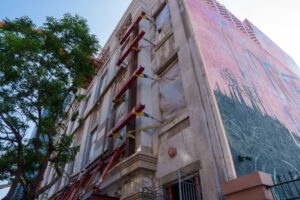
Weeks after the partial collapse, once the building was secured to the ground, crews were able to go to the second and third floors to address another big concern – the wall along O’Keefe Avenue had separated
from the rest of the structure at the bottom floors and peeled out
toward the street.
“The next big milestone, at least in my mind, was restraining that front wall,” Patrick Abry said. “That was a huge milestone for us, and I think a huge milestone for the city to make sure that that was held back, and again, that wasn’t one individual day. We tied the wall back, and then we’d stand back and we’d assess. The engineers came in and said, well
actually, there’s another section over here that needs to be restrained, and so we put a big vertical beam up the side of the building.”
Following the initial stabilization, how to best support the building was a constant process of rethinking strategy. Atkinson-Noland and Associates, a Colorado structural engineering firm with special expertise in nondestructive testing, diagnostics, and investigation, placed gauges in the larger cracks to monitor for any additional movement. Penetrating radar looked inside the walls to offer a better understanding of what was going on inside, and a videoscope made its way through tiny holes drilled in the masonry.
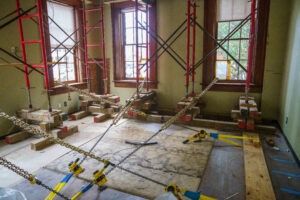
And once engineers finalized plans for repairs, a different type of shoring had to be put in place to allow for the work.
That work included replacing the old brick columns that contributed to the partial collapse with concrete columns reinforced with steel. In order to do so, the weight of the massive building had to be taken off the old columns and put on a system of 100-ton jacks – putting just short of a million pounds of force on the building to hold it up while the steel fabricators came in and did their work. It also replicated what the load would be on the building’s foundation when the temporary shoring was released.
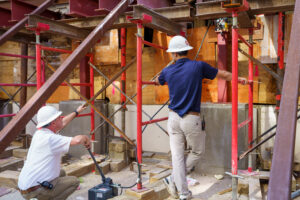
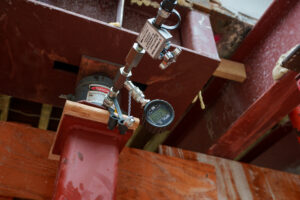
That big moment came in early June 2026 when that load was transferred onto the new columns and Turners’ Hall was finally able to stand on its own again.
“This was a huge, very impressive project that is not something normal for us,” Patrick Abry said. “It’s a testament to the leadership at the LEH that they were able to move quickly with this and get everybody involved. I was very, very proud to be a part of that team, because if it happened nine out of 10 times, in my opinion, I don’t think this building would have stood up. I think it’s a testament to everybody who worked together to make sure that this happened. That’s why it’s still here.”
Previous Posts
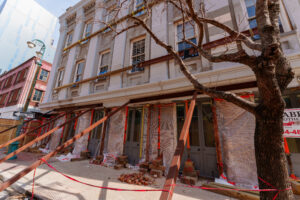
It was around 8 p.m. on a Saturday when longtime building engineer Henry Holmes answered a call from the New Orleans Fire Department. Turners’ Hall, the building he had cared for for more than 40 years, was in trouble.
He immediately pulled up video footage from the building.
“I actually saw part of the building crumbling on the O’Keefe Street side,” he said. “A few minutes later all I saw was a cloud of dust, and then the camera went out.”
The partial collapse of the building and its imminent restoration and rebuilding is yet another chapter in the long history of Turners’ Hall.
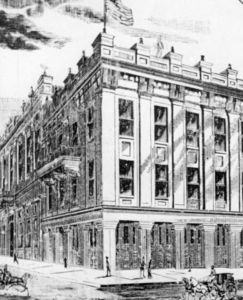
Built in 1868 for the Society of Turners, a German benevolent association, German-born architect and surveyor William Thiel planned a palazzo-style building with a façade featuring 13 two-story high pilasters, eight facing the O’Keefe Street side. Its original use was as a gymnasium with an upper-level auditorium adjoining offices and a ballroom.
The Picayune described Turners’ Hall an “Aladdin’s palace, grand in character and design,
and a worthy monument to the genius and patient labor of the population which called it
into existence,” according to an article in 64 Parishes magazine.
As the City of New Orleans evolved around Turners’ Hall, so did its use. It spent time as a publishing company and furniture store, before being purchased by its current owner,
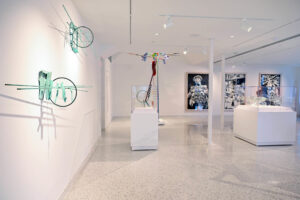
the Louisiana Endowment for the Humanities, in 2000. The LEH, a statewide nonprofit dedicated to preserving and promoting Louisiana’s culture and history and improving educational outcomes for children and families, used the building as its headquarters, hosting public programming, housing staff offices, and leasing space to business tenants. In 2021, the LEH completed a $3 million renovation of the first floor and celebrated the opening of The Helis Foundation John Scott Center, an art gallery and community-gathering space dedicated to the work of New Orleans artist John T. Scott.
The grand opening after years of planning and work was one of Holmes’ most memorable moments.
“It was something to actually see the dreams you had come true, and the smiles on the entire staff, that we did it,” he said.

In 2024, as good stewards of the beloved building, the LEH launched another renovation to ensure the continued preservation of its historic home. Work on the building’s facade was being advanced to repair stucco, tuckpoint columns, and prepare surfaces for new paint. On the evening of December 14, the pilasters along the corner of O’Keefe Avenue and Lafayette Streets began to fail and partially collapse.
Within hours of being notified of the partial collapse on December 14, 2024, the LEH had assembled a team whose sole mission was to ensure the safety of the surrounding community and preserve the building’s integrity.
The core stabilization team included structural engineer Jamie Saxon, from Morphy Makofsky, shoring company Abry Brothers, and general contractor Woodward Design/Build, all supported by city agencies that included safety, permitting, transportation, the Historic District Landmarks Commission, and the New Orleans City Council.
Over the next eight weeks, successive layers of additional shoring were added as more guidance came in. While a coordinated effort to establish a long-term strategic plan was under way, interim shoring was put in place to stabilize the existing building and prevent further movement of the facade and connected floor joists.
Six engineering companies from across the United States have been engaged at various points to identify structural failures and guidance on the build back. Their work included installing monitors on the building, which broadcast 24/7 any movement on cracks exceeding one thousandth of an inch and ongoing frequent physical surveys of the entire property to identify any movement of facades. Monitoring systems show that the facade has moved only a fourth of an inch since the event occurred, roughly the width of a dry red bean.
Within the first three months of the partial collapse, $700,000 had been spent to ensure the immediate safety of the surrounding area, with the entire stabilization project totaling $6.5 million when completed in 2026.
By the fall of 2025, the engineering analysis and insurance company reviews had been concluded, and the structural restoration work plan was filed with the City of New Orleans and the Historic District Landmarks Commission for permitting. Construction commenced on December 8, 2025.

Historic components, including fireplaces, doors, windows, an interior sculpted arch, and exterior balconies, were carefully salvaged for eventual restoration. Art conservationists were engaged to remove the collection of John Scott’s art to safety.
Trapolin-Peer Architects and Woodward Design/Build are leading the current construction phase to rebuild the damage caused by the collapse, including replacing the brick columns with steel and concrete, which will be sheathed in stucco to match the original look of the building.
For Holmes, who was only months away from retirement when
he got the call, making sure the building can safely stand for several hundred more years might be his last, but most
important, assignment.
While the complex team of engineers, architects, city officials, and LEH leadership works to ensure the safety of the building while also putting plans in motion for its restoration, Holmes – who knows the building better than anyone – now spends his days acting as the point of contact for construction crews on the ground. Just months away from retirement when he got the call, he says for now that will have to wait.
“It happened on our watch,” he said. “I always said leave things the way that you found them or better, so my thing is I’m going to stick around and help get this thing back together.”